

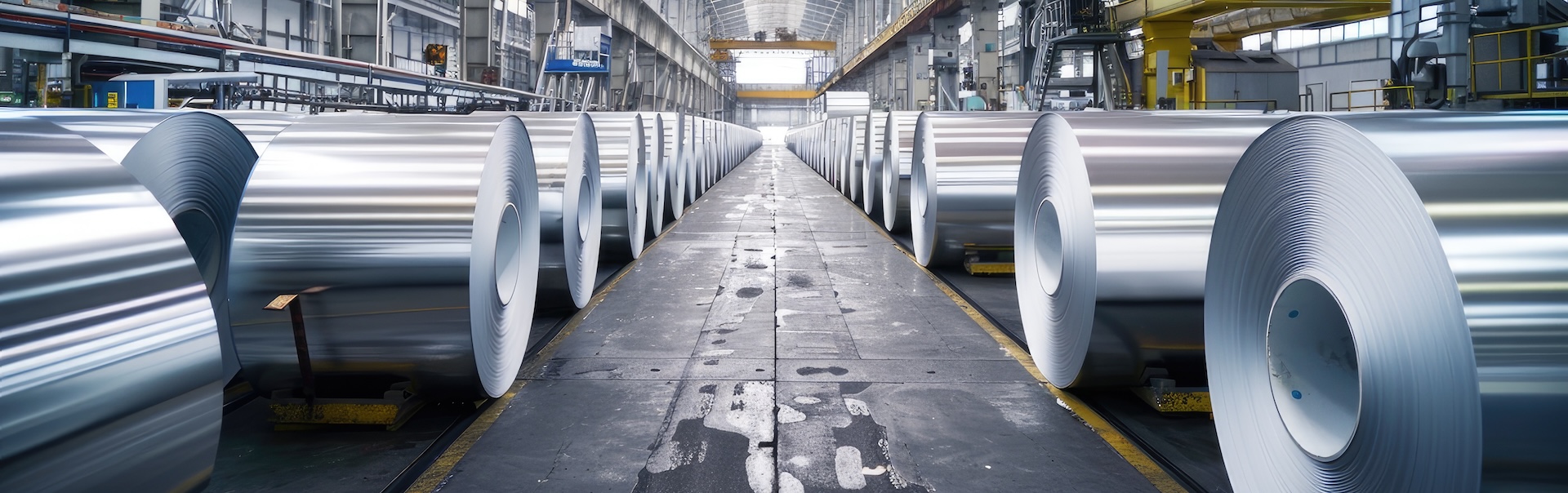
An aluminium mill improved quality, yield and cost through Operational Excellence, cutting overall casting rejection, reducing superficial line and temper-related defects delivering significant financial gains driven by cross-functional, data-led problem solving with shop-floor validation, experiments and standardisation.
Context and Challenges
A leading aluminium cold rolling mill producing circles, sheets and coils for cookware and other downstream applications was facing multiple quality and yield issues across casting, annealing and finishing:
- Frequent white rust (corrosion) rejections, especially condensation-type white rust noticed at customer warehouses.
- High casting rejections (~1.64%) driven by superficial lines and poor temper in circles and sheets.
- Temper issues after annealing, causing differential hardness on circles and leading to cracks and breakages at customers.
Our Approach
The improvement roadmap was structured to focus on major quality problems in different processes. Each project followed a disciplined problem-solving approach: data analysis, cause & effect / differential diagnosis, shop-floor validation, experiments and standardisation. Cross-functional teams from production, maintenance, quality and planning were involved throughout.
Key Strategies Implemented
Casting Rejection Reduction – Superficial Lines & Temper
- Problem definition & analysis: Baseline casting rejections averaged 1.64%, with superficial lines and poor temper as top two defects. Cause & effect analysis highlighted casting speed, fluxing, tip design, metal temperature at head box / filter box, cooling and temperature controller calibration as key factors for superficial lines; and loading pattern, thermocouple insertion, alloy type and furnace conditions for temper problems.
- Gemba verification & design changes: At the caster, differences were found between actual and indicated temperatures in the head box and filter box and uneven metal flow at the centre of the casting tip. A redesigned tip and relocated thermocouple in the filter box improved temperature sensing and slowed metal flow at the centre with a small ceramic insert, reducing hot-spot formation. For temper issues, door leakages on annealers were identified; loading patterns were studied and corrected using bundle-height experiments Gauges were introduced to control loading height.
White Rust (Condensation) Reduction
- Problem understanding & diagnosis: White rust mechanisms were analysed; condensation-type white rust was chosen as project focus after breakdown of sample data. Differential diagnosis compared affected vs non-affected orders across parameters such as gauge, diameter, alloy, temper, operations (CRM, slitting, blanking, annealing), packing practices and storage/transport conditions. Analysis showed occurrence was not strongly linked to gauge, diameter, alloy or temper, but pointed towards packaging, moisture, temperature and transport conditions (e.g., water drums in trucks, stretch wrapping, hot packing, dew-point behaviour).
- Design of Experiments: A series of drum experiments varied conditions like water at bottom, stretch wrap, oiling, interleaving and silica gel under cold and hot packing situations. Key findings were stretch wrap increased moisture collection and hence risk of white rust., Water in container bottoms aggravated condensation on circles, hot packing of oiled circles accelerated white rust; unoiled circles under normal conditions were more prone than oiled. Interleaving and silica gel both reduced or delayed white rust formation.
Results Achieved
- Casting quality: Overall casting rejections reduced by about 50% within three months. Superficial lines and temper-related defects reduced by more than 90%, significantly improving circle and sheet quality.
- White rust / corrosion: Condensation white rust rejections at the key customer were driven to zero, with annual benefits exceeding USD 100,000 through avoided scrap, sorting and claims.