

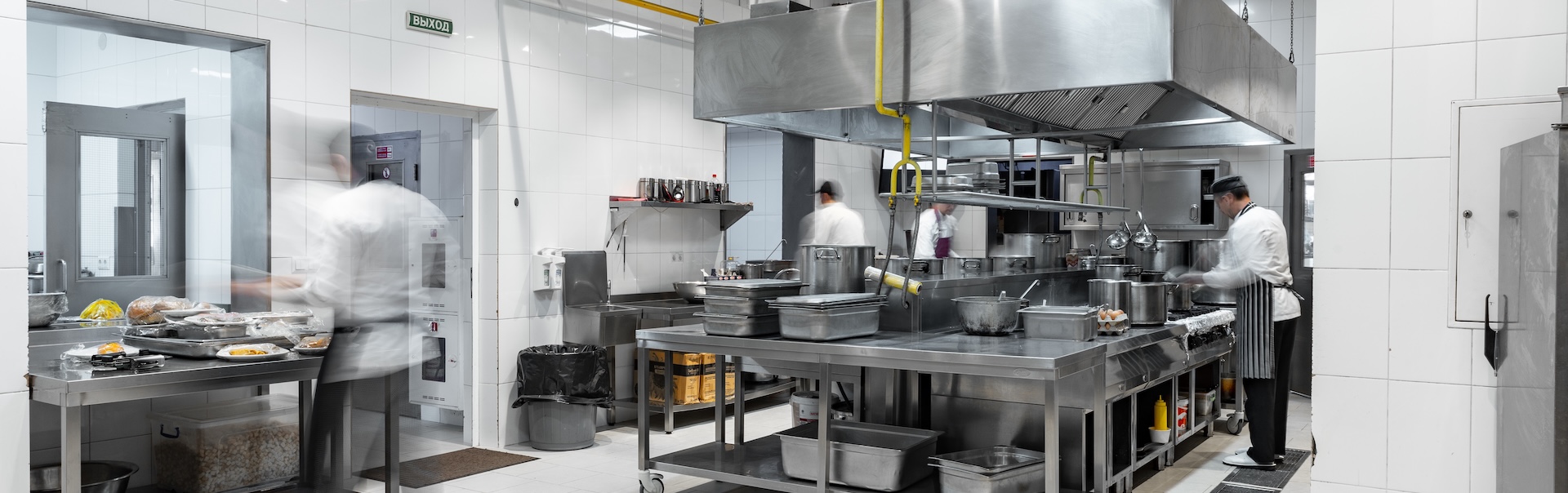
Using Lean Layout Design and Kaizen principles, RIBCON helped design a new macro-layout for the central facility that sharply reduces material movement, separates clean and dirty streams, and provides a scalable platform for future volume growth.
Context and Challenges
A fast-growing restaurant and café chain was operating a central bakery and preparation kitchen supplying over 25 branches, with plans to grow to 60+ outlets in the near term and 150 branches over time. The existing backend facility comprised three levels production facility, raw material stores, bakery, prep kitchen, cold rooms, crate washing, dispatch and staff areas. Key issues included:
- Criss-cross material movement – incoming raw materials and outgoing finished products shared the same entry and circulation routes, causing congestion, confusion and safety risks.
- Heavy vertical and horizontal movement of raw materials between godowns and floors using hoists, with multiple up–down transfers for both production and branch dispatch.
- Congested production zones in bakery and prep kitchen, with zig-zag flows, overlapping activities and container/crate cleaning happening close to food preparation areas.
- Sub-optimal location of support areas such as canteen, changing rooms, asset store and cold stores, leading to unnecessary walking and poor utilisation of space.
- Lack of a clear long-term layout plan to support expansion from 26 to 60+ branches and beyond.
Our Approach
RIBCON conducted a 5-day Lean Layout Design workshop with production, stores and logistics teams, following a structured approach:
- Clarified future-state requirements – volumes for Phase 1 (60 branches) and flexibility for Phase 2 (150 branches).
- Created current-state flow maps for raw materials, finished goods, crates and people, including travel distances and hoist usage between floors.
- Evaluated layout options across three levels, using Lean principles of unidirectional flow, cellular manufacturing, separation of clean/dirty streams, proximity to points of use and minimal vertical transfers.
- Developed a detailed layout indicating section locations, approximate areas, major flows and material-handling concepts, followed by detailed movement analysis to quantify benefits.
- Identified & implemented priority Lean Kaizen projects in kitchen operations, bakery, stores and dispatch to be run after layout implementation.
Key Layout & Flow Improvements
Separation of Incoming and Outgoing Flows
- Designed dedicated receipt and dispatch zones
- Eliminated criss-cross of inbound and outbound trolleys in shared aisles.
- De-cluttered dispatch area, no overlap between receipt and dispatch
Optimised Raw Material Movement for Branches & internal processes
- Shifted raw material storage for branches near to point of dispatch
- New picking cell for branches located next to receipt and dispatch.
- Eliminate Hoist usage for branch materials
- Unidirectional and shorter flow achieved; total movement distance for branch raw materials reduced by about 62%.
- Re-located production raw material stores to closer and more central to both bakery & prep kitchen
- For bakery: unidirectional flow with reduced hoist use; total movement cut by 67% versus earlier arrangement.
- For prep kitchen: simplified route and fewer vertical movements; total travel distance reduced by 49%.
Crate Cleaning Flow & Hygiene Improvement
- Moved empty crate cleaning from production area away from bakery and prep kitchen resulting No dirty crates passing through production areas.
- Dirty crate movement distance was reduced by around 68%.
- Planned cleaning machine to enhance productivity and quality of crate washing.
Bakery and Prep Kitchen Layouts Supporting Flow
- Bakery layout: removed zig-zag routing and designed clearer product flow with separate entry and exit, and a specially designed exit to minimise cross-contamination and spread of odours.
- Prep kitchen layout: re-organised macro layout so that Butchery (highest material movement) is placed next to the finished product hoist, Hot kitchen sits under the suction ducting as per infrastructure constraints.
- Salads & sandwiches, cold storage and utensils washing areas each have independent material flows without cross-over.
- Achieved Less congestion, clearer zoning by process, improved hygiene and simpler supervision.
Better Use of Support Spaces
- Canteen relocated from a small ground-floor corner to a larger, centrally positioned area, away from washrooms and changing rooms, with nearly double space.
- Asset stores and cold rooms redistributed for better accessibility and future expansion space reserved.
Lean Kaizen Implementation – Backend Kitchen & Bakery
Alongside the layout, key Lean Kaizen projects were identified & implemented to unlock productivity and cost benefits after implementation:
- Preparation Kitchen
- Productivity improvement in beef burger line using cellular layout and line balancing.
- WIP and throughput time (TPT) reduction in chicken breast operations.
- MUDA elimination in hot kitchen and salads/sandwich areas, plus visual management and standardisation.
- Bakery
- TPT improvement in pre-baking area with balanced cells.
- Energy saving in ovens via standard load design, baking sequence optimisation and small engineering changes.
- Raw Material Stores & Dispatch
- Detailed layout with locations by usage frequency, FIFO and optimal flow.
- Productivity improvement through Mizusumashi (water-spider) design for production supply and picking cells for dispatch to branches.
- Inventory management and external logistics design for better truck utilisation and transport cost control.
Results Achieved
- 30% manpower productivity improvement in beef burger operations through cellular layout and line balancing.
- 25% reduction in throughput time and WIP for chicken breast processing.
- 25% reduction in throughput time in bakery pre-baking area with balanced cells.
- 30% reduction in oven energy cost through standard load patterns, sequencing and engineering modifications.
- 45% manpower productivity improvement in raw material supply (water spider) and in picking cells for branch dispatch.
By redesigning the backend layout using Lean principles and combining it with a clear Kaizen roadmap & implementation, the restaurant chain transformed its central kitchen and bakery from a congested, high-movement facility into a flow-oriented, hygienic and scalable production hub.