

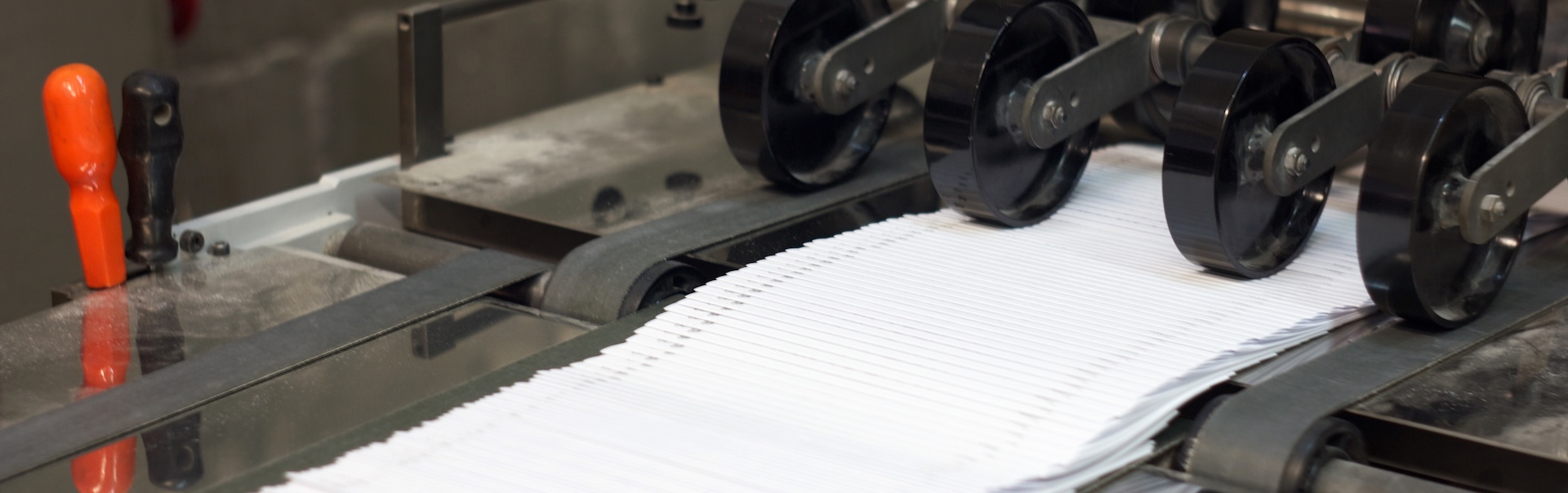
A full value stream mapping exercise on the exercise-book line, combined with redesigned layout, mizusumashi routes, supermarkets, standard work and lean store controls, turned a cluttered, high-WIP environment into a controlled, flow-driven stationery value stream with clearer lead times, faster response to orders and better stock visibility.
Context and Challenges
A leading exercise-book and stationery manufacturer was struggling with poor flow and low visibility in its exercise-book value stream:
- Unclear material flow and congestion: Pallets of WIP and finished books blocked pathways; temporary FG and supermarkets were used as long-term storage; rejects were mixed with good WIP. Aisles were filled with stacks of note books WIP, trolleys and pallets, leaving operators and material handlers little space to move.
- Weak order and information flow: No formal order-processing flow chart; printers handled multiple plans at once; covers were not produced in sequence; the visual tracking board was poorly used, replaced by loose papers and notebooks; sales had no reliable feedback on order status.
- Material handlers / Mizusumashi not following designed routes: WIP and covers were moved ad-hoc, often bypassing supermarkets and bringing material directly from suppliers or upstream cells, increasing WIP and masking bottlenecks. Trim waste was not picked up on time, creating clutter and dust.
- Disorganised stores and stock information: Multiple stores (RM, consumables, FG, WIP) existed across the plant, but locations, item categories and movement patterns were not standardised. Stock was often “available but not findable”, leading to perceived stock-outs and delays while physical counts were done.
Management wanted to stabilise flow in the stationery value stream, reduce WIP and lead time, and create a robust backbone in stores and logistics to support future growth.
Our Approach
Using a PDCA-based Kaizen workshop format, the team followed a four-step approach:
Assessment & Value stream mapping
- Conducted gemba walks on the exercise value stream to document before-Kaizen conditions, abnormalities and layout issues
- Created a defect matrix showing which process produced which defects (tapered cutting, wrong margin size, blank pages, ruling misalignment, no stitching, less pages, torn pages, wrong size, wrong labelling), with associated methods of checking and references to SOPs/OPLs.
- Developed current state VSMs for key product families (Binding Lines 1 & 2, packet, spiral, loose leaf, filing), capturing cycle times at each step, lead times between processes and overall value-added ratio (around 13% for major lines).
Identification of Key Focus Areas
- Prioritised issues affecting flow: Material flow, material handler / mizusumashi routes, unorganised supermarkets and lack of sequence adherence in various processes such as cover printing, lack of order tracking, and mixed WIP/rejects.
- Identification of Impact of downtimes, changeovers, defects and other OEE losses on Overall lead time and identification of key TPM strategies
- Flagged stores-related wastes: mixed categories in the same store, missing triggers, and inconsistent recording of receipts/issues leading to unreliable data and long search times.
Flow Redesign & Standardisation
- Design flow based layout and cells, with balanced processes between all processes and machines i.e. sheeting, collection, folding, book making, final cutting and packing.
- Redesigned material-handler / mizusumashi routes for covers, WIP, trim waste and FG, using clear route maps (e.g., for covers, dedicated routes for WIP and trim waste) and boards at starting points in the temporary FG area.
- Defined order-processing flow from sales to design, plate making, printing, binding, packing and FG, supported by a design pipeline template and rules for production sequences and changeovers.
- Set up standard work for the VSM supervisor, including hourly checks of Kanban boxes and production sheets, gemba walks, route audits, demand pipeline updates, skill-matrix reviews and 5S checks, time-boxed across the day.
Pull systems & Store Layout Design
- Designed Pull system and supermarkets for inventory flow and control for different value streams
- Mapped flow of material in all stores and process of receipt and issue documents, and created flow based layout based on Runners, repeaters & strangers to minimise movement times and improved 5S
- Designed and rolled out standardised material movement with clear fields for quantities, locations, zones and Kanban card movements, plus SOPs for production→FG and FG→dispatch transfers.
Key Strategies Implemented
Flow-Based Layout in Exercise book Value Stream
- Cells were created in book making area, Sheeting, folding & collections sections to minimise WIP, improve flow and reduce lead time
- Standard Mizusumashi for covers, WIP, FG and trim waste were introduced and simplified (e.g., moving from two FG routes to a single standard route) so material handlers could follow fixed loops at defined frequencies.
- Pathways around key machines were cleared and marked, creating visible lanes that separate walkways, WIP zones and temporary FG storage. Before/after photos show the transition from congested aisles to clear, marked paths.
TPM & SMED Implementation
- Implementation of TPM pillars - Autonomous maintenance, planned maintenance, Root cause analysis in bottleneck machines in collection, folding, sheeting sections
- Implemented SMED practices to reduce changeover times and TWI to improve operator skills
Visual Order Management & Demand Pipeline
- A structured order flow chart was created, clarifying steps from when sales receives an order, through design confirmation, plate readiness, production and packing, to final dispatch.
- A demand pipeline board and design pipeline sheet track each order with customer name, school name, order date, plate issue date and size/page details, giving everyone a single source of truth on priorities and ageing.
- Rules were set for production sequencing and changeovers (page, size, ruling, reel) with standard times and frequencies, helping stabilise planning and reduce unnecessary changeovers.
Standard Work & Daily Management
- The VSM supervisor’s daily standard work was established covering checking Kanban cards and Heijunka boxes, verifying raw material and supermarket status, reviewing abnormality sheets, auditing routes and standard work at cells, updating the demand pipeline and ensuring daily cleaning & 5S.
- Abnormality boards and sheets to capture issues on routes, supermarkets, labelling, mix-ups and missing material, triggering immediate action plans and follow-up.
Lean Stores & Stock Accuracy
- Flow based layout and standard inventories were established in all stores.
- SOPs for material movement production to FG stores via Kanban and from FG to dispatch
- Safety and 5S issues in stores (e.g., open wiring near covers, no safety gates, cluttered dispatch areas, toilets used as storage) were addressed with clear demarcations, safety gates, painting and standard height lines.
Results Achieved
- Improved flow and reduced lead time by 30% on the exercise-book line
- Reduced breakdowns and changeover times by 40%
- Reduced inventory levels by 40% and utilised space by 30%
- Reduced Order processing turnaround time by 30%