RIBCON

Line Balancing is a key Lean Manufacturing technique used to evenly distribute work across all workstations in a production or assembly line. The goal is to match the workload at each station to the TAKT Time—the pace required to meet customer demand—thereby reducing bottlenecks, idle time, and operator fatigue while improving manpower productivity and process efficiency.




Improvement in manpower productivity
Reduction in manpower costs
Reduction in space utilization
Reduction in WIP
The first step is to capture a detailed cycle time study of each process and operator using Time & Motion Study or Videography. This helps establish a clear understanding of how long each task takes under actual working conditions.
By observing and evaluating how tasks are performed on the shop floor or in service environments, we help businesses unlock hidden potential in their day-to-day operations.
TAKT Time defines the maximum time allowed to produce one unit in order to meet customer demand.
TAKT Time = Available Production Time / Customer Demand. This becomes the benchmark against which each workstation’s workload is measured. It helps:
Create a Line Balance Chart that plots the duration of each process step against TAKT Time. This visual tool helps to:
To determine the optimal number of operators, target manpower is calculated as:
Target Manpower = Total Work Content / TAKT Time
Total Work Content is the sum of manual task durations required to complete one cycle of production. Only manual cycle times are included; machine automatic times should be excluded.
This figure provides a theoretical benchmark for how many operators are ideally needed in a fully balanced line, forming the foundation for resource planning and cost optimization.
The next step is to redistribute tasks or eliminate Non-Value-Adding (NVA) activities to bring each workstation’s load as close to TAKT Time as possible. This may include:
The objective is to achieve uniform workload distribution and eliminate inefficiencies that cause delays, waiting, or overburdening.
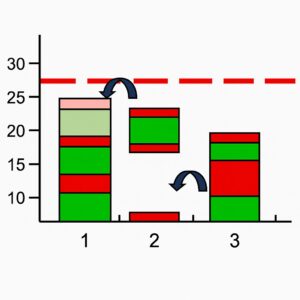
Yamazumi Chart
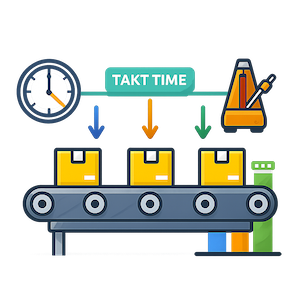
TAKT time
Time and Motion Study

Line Balance Chart
Clients
Industries
Projects implemented
With experience across diverse industries and challenges, we deliver unparalleled insights and solutions especially designed as per the needs. For more details, contact us today!