Desktop Banner
Mobile Banner

Process Mapping

Eliminate Hidden Inefficiencies and Transforming Office Workflows for Higher Productivity

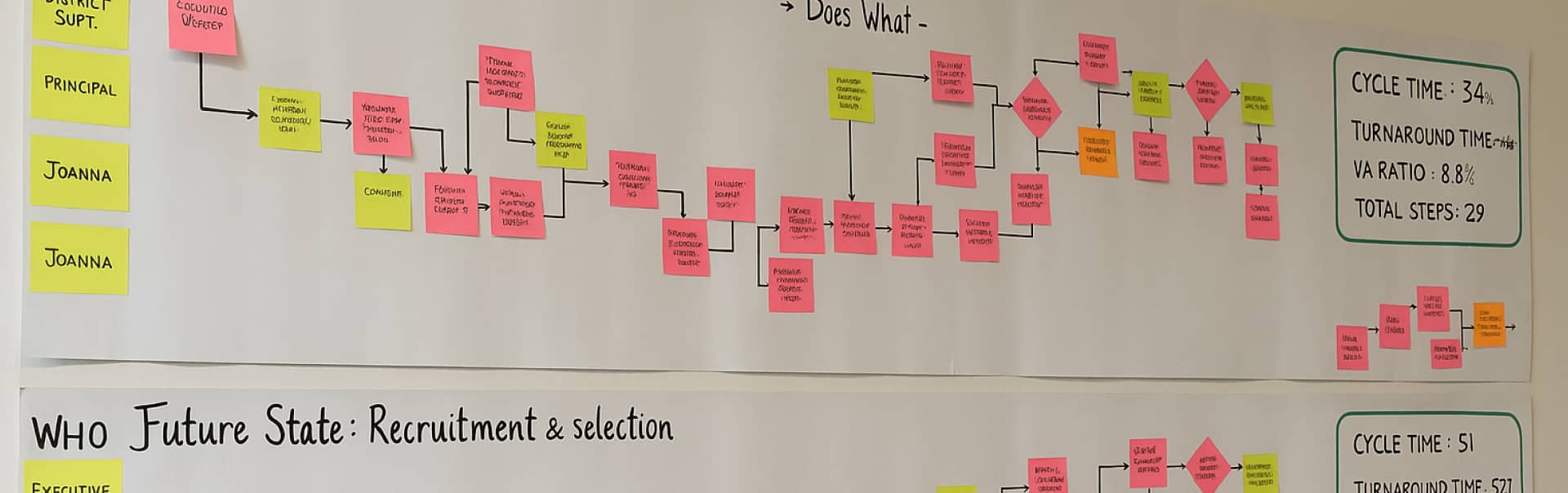
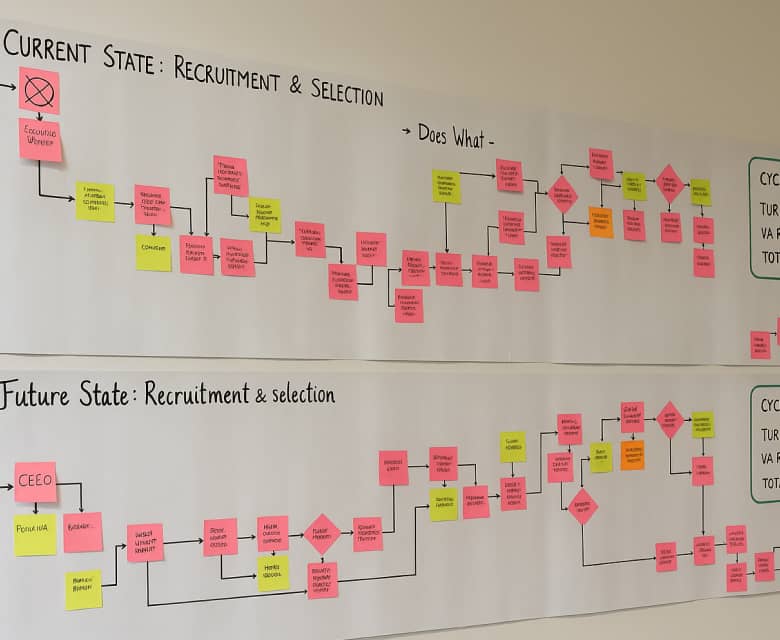
Process Mapping is a visual Lean tool of how work & activities flows within a process. It captures each activity, decision point, handoff, and responsibility across functions and helps understand total turnaround time of process and time wasted in value adding and non value adding activities

In office and support environments—where tasks are often abstract and cross-departmental—process mapping helps identify who does what, when, where, and how, creating clarity that is often lacking. At its core, process mapping shifts the view from “departmental silos” to a flow perspective, enabling teams to see the end-to-end journey of information, documents, and decisions

Unlike shop-floor operations, office processes are often less visible—making bottlenecks, delays, and rework difficult to detect. They tend to be highly variable, with each person or team working differently, and cross-functional in nature, where tasks frequently pass between departments, leading to “over-the-wall” issues. Process Mapping brings clarity by making these workflows transparent and measurable, enabling fact-based improvements

Process Mapping is not just a visualization tool—it is a strategic Lean method for uncovering hidden inefficiencies in office and support processes. By making processes transparent, measurable, and team-driven, organizations can reduce lead times, improve quality and accuracy, cut costs and enhance both customer and employee satisfaction.



Benefits of Process Mapping

Visibility & Transparency

  • Clarifies roles and responsibilities (“Who does what?”).
  • Reduces ambiguity and duplication of effort

Identification of Waste

  • Helps distinguish value added vs. non value added steps
  • Makes waste such as waiting, searching, rework, and excess approvals visible

Improved Flow & Productivity

  • Shortens lead times by eliminating delays and bottlenecks
  • Enhances process speed and accuracy

Builds Ownership

  • Encourages staff involvement in designing their own processes.
  • Builds ownership and accountability.

Our Process Mapping Experience & Impact

0 + 100

Projects

0 + 75

Clients

0 + 2000

People trained

+ 0 % +30

Reduction in process turnaround time

Steps of implementing Process Mapping

Define the Scope & collect information
  • Agree on process boundaries (start and end points). 
  • Clarify purpose and expected outcomes from process mapping.
  • Engage people directly involved and document how tasks are currently performed (not how they should be).
Visualize the Current State
  • Create a flowchart, swimlane diagram, or value stream map. 
  • Capture all activities, decisions, documents, and handoffs.
Identify Waste and Bottlenecks
  • Apply 5W1H questioning (Why, What, Where, When, Who, How). 
  • Analyze for waiting, errors, duplication, unnecessary steps.
Design the Future State based on ECRS
  • Identify unnecessary tasks, tasks that can be combined, Rearranged for smoother flow & Simplified to reduce complexity. 
  • Define a streamlined process with fewer handoffs and delays. 
  • Establish measurable targets (e.g., lead time reduction, error rate reduction).
Implement and Monitor
  • Pilot the new process with a small team. 
  • Track KPIs such as turnaround time, error rates, customer/staff satisfaction.


Advanced Lean Manufacturing Tools

Connect with our Experts!

With experience across diverse industries and challenges, we deliver unparalleled insights and solutions especially designed as per the needs. For more details, contact us today!


contact-with-expert-form